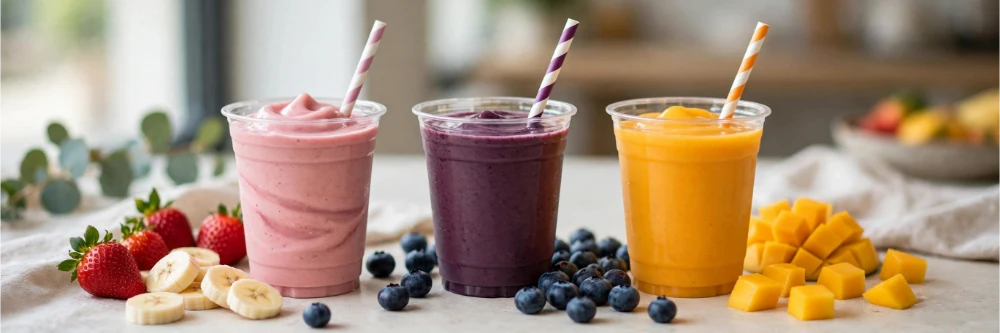
Sheetz Smoothie Menu: Every Flavor, Prices, and What’s Worth Ordering
Sheetz smoothies are made to order at the touchscreen kiosk and blended fresh with fruit, yogurt, and syrups. They sit in a category of their own on the drinks menu: thicker than a slushie, lighter than a milkshake, and filling enough to count as a snack rather than just something to sip. Most Sheetz locations serve them all day, which makes them as common at breakfast as they are on a summer afternoon.
This page covers the complete smoothie menu: every regular flavor and what it actually tastes like, the full price and calorie table, the protein and energy add-ins that most people scroll past at the kiosk, how to order and customize one, and honest picks for different goals — the lowest-calorie option, the best post-workout choice, and the one worth your money if you only try a single smoothie.
What Exactly Is a Sheetz Smoothie?
A Sheetz smoothie starts at the Made-To-Order (MTO) touchscreen, the same kiosk used for sandwiches and burgers. You pick a flavor, choose a size, add any boosts the store offers, and the drink is blended to order behind the counter while you wait. Nothing is sitting pre-made in a cooler — that is the first thing that separates these smoothies from the bottled drinks in the grab-and-go case.
The base of a standard Sheetz smoothie is a fruit blend — real fruit flavors carried by fruit purees and syrups — with yogurt used in some blends for body and tang. The result is a dense, spoon-coating texture, noticeably thicker than the icy crunch of a slushie. Because the drinks are blended to order, two smoothies with the same name can differ slightly between stores and between visits; sweetness and thickness depend on the blend and on whoever is running the blender. Treat every flavor description and calorie figure on this page as the typical case, not a laboratory measurement.
Sheetz Smoothie Flavors
The regular lineup is small and consistent — six blends you will find at most locations, built from a short list of fruits. Here is what each one is, and who it suits.
Strawberry Banana
The most popular smoothie at Sheetz, and the one to start with if you have never ordered from this menu. Strawberry and banana are both mild flavors that blend together without fighting, so the drink tastes balanced rather than sharply fruity. Banana does most of the work on texture, which makes this one of the thicker standard blends. It is the safest pick for kids and for anyone who finds berry drinks too tart, and it is the base that takes protein add-ins best, because the banana covers the taste of the powder. Typical price $3.99 – $4.99, about 280–320 calories for a regular.
Berry Patch
The Berry Patch combines blueberry, strawberry, and raspberry into a drink that leans berry-forward without becoming overly sweet. Raspberry gives it a slight edge that the Strawberry Banana does not have, and the color alone tells you this is the most fruit-dense of the standard blends. It suits people who find single-fruit smoothies one-dimensional. Because berries carry natural tartness, this is also one of the better choices if you are watching sweetness — it tastes full without relying as heavily on syrup. Typical price $4.29 – $4.99, about 270–300 calories for a regular.
Tropical Mango
The Tropical Mango is the lightest-feeling blend on the menu — less thick than the berry drinks, with a cleaner, sunnier flavor that works best in warm weather. Mango brings its own natural body, so the drink stays smooth without needing as much yogurt or banana behind it. If standard smoothies feel heavy to you, start here. It is also a good first smoothie for people who usually order slushies, because the flavor profile is closer to a frozen fruit drink than to a dessert. Typical price $4.29 – $4.99, about 265–295 calories for a regular.
Mango
The plain Mango smoothie is for purists: one fruit, one clean flavor, nothing competing with it. It runs slightly sweeter and simpler than the Tropical Mango, and it is the easiest drink on the menu to predict before you taste it. Mango is also, quietly, one of the lightest regular options on the whole smoothie menu at about 260–290 calories, which makes it a regular pick for people who want the fruit without the dessert-level richness of a shake. Typical price $4.29 – $4.99. If your store lists both Mango and Tropical Mango, expect the tropical version to taste a little brighter and less dense.
Mixed Berry
Mixed Berry uses the same strawberry, blueberry, and raspberry trio as the Berry Patch, but with a slightly less sweet profile that some regulars actively prefer. Think of it as the Berry Patch turned down one notch on sugar and up one notch on tartness. It is a good example of why it pays to read the kiosk screen instead of ordering on autopilot: two drinks with nearly identical ingredient lists sit side by side on the menu, and the difference only shows up in the cup. Typical price $4.29 – $4.99, about 265–300 calories for a regular — joint-lightest of the berry options.
Strawberry Pineapple Banana (with Yogurt)
The creamiest smoothie Sheetz sells, thanks to an explicit yogurt base. Strawberry and banana provide the familiar base, pineapple cuts through with a sharper, tangier top note, and the yogurt gives the whole drink a soft-serve-adjacent body that the other blends do not have. It is also the richest standard smoothie on the menu — about 310–370 calories for a regular, at $4.49 – $5.49 — so it sits closest to milkshake territory while still counting as a fruit smoothie. Order it when you want the smoothie version of dessert, or as a breakfast that actually fills you up.
Sheetz Smoothie Prices and Calories
Prices at Sheetz are set regionally and change over time, so no online table — including this one — can promise the exact figure at your store. What the table does give you is the typical range for a regular size at most locations, which is what you should budget around.
| Smoothie | Price Range | Calories (Regular) |
|---|---|---|
| Strawberry Banana | $3.99 – $4.99 | 280–320 |
| Berry Patch | $4.29 – $4.99 | 270–300 |
| Tropical Mango | $4.29 – $4.99 | 265–295 |
| Mango | $4.29 – $4.99 | 260–290 |
| Mixed Berry | $4.29 – $4.99 | 265–300 |
| Strawberry Pineapple Banana (with yogurt) | $4.49 – $5.49 | 310–370 |
Sizes move the price. The ranges above reflect the standard regular size most people order; stepping up to a large adds to both the price and the calorie count, while a smaller cup brings both down. Exact size names and prices are shown on the kiosk at your store and in the Sheetz app, and both are more current than any website — check there before a big order.
On calories, the pattern is simple: the yogurt-based blend is the richest, the single-fruit and mixed-berry blends are the lightest, and everything else sits in between. Add-ins change the math — protein powder and extra syrups push the count up, which is why the calculator matters. For the full nutrition of any drink on the menu, use the Sheetz nutrition calculator →.
Protein and Energy-Infused Smoothies
This is where the Sheetz smoothie menu pulls ahead of most convenience-store chains. At many locations, any standard smoothie can be boosted at the kiosk with protein powder or an energy add-in for a small upcharge. Most chains in this category sell you a fixed bottle from a cooler; Sheetz builds the boosted drink in front of you, on the flavor you actually wanted.
A protein smoothie typically lands around $5.49 – $7.49 depending on size and add-ins, and it changes what the drink is for. A regular fruit smoothie is a snack; a protein version is a light meal replacement — the thing you grab after a workout, on a road trip when the next real meal is hours away, or at 6 a.m. when a breakfast sandwich feels like too much. Berry and banana bases hide the taste of protein powder best; the Berry Patch and Strawberry Banana are the regulars’ usual vehicles for it.
Energy add-ins push the drink the other way — same fruit base, with a caffeine-style lift layered in, aimed at drivers and shift workers rather than gym bags. Availability of both add-in types varies by location and sometimes by time of day, so treat them as a kiosk-screen bonus rather than a guarantee: if your store offers them, they appear as options on the smoothie screen when you order.
How to Order and Customize a Sheetz Smoothie
Ordering happens at the MTO touchscreen inside the store, or ahead of time in the Sheetz app at participating locations. Pick the smoothie category, choose your flavor and size, add any boosts offered, pay, and your drink is called at the MTO counter when it is ready — the same flow as ordering a sandwich. If the store is busy, app ordering is the faster route, because your smoothie joins the queue before you walk in.
Options vary by location, but the customizations you will most often see are:
- Size — regular or large on most blends
- Protein or energy add-ins, where offered
- Extra fruit, where the kiosk allows it
- Yogurt base on applicable flavors
- Less or no added syrup on some blends — ask at the counter if the screen does not offer it
One practical tip: smoothies are blended to order, so they take a few minutes longer than pouring a fountain drink. Order yours first, then do the rest of your shopping — by the time you are done, the cup is usually waiting.
Smoothies vs. Slushies vs. Milkshakes
These three get confused constantly, and they are built completely differently. A slushie is ice and flavored syrup churned in a machine — crunchy, very sweet, and the cheapest frozen drink in the store. A smoothie is fruit blended smooth with yogurt or fruit bases — dense, filling, and the only one of the three that works as a snack or light meal. A milkshake is ice-cream-based — a dessert, full stop — including the F’real shakes from the freezer case, which are blended in the F’real machine rather than at the MTO counter.
Price follows the same ladder: slushies at the bottom, smoothies in the middle, shakes at the top. If you want refreshment, order a slushie; if you want food in a cup, order a smoothie; if you want dessert, order a shake. For the full shake lineup, see our Sheetz milkshakes menu → — and for every drink category in one place, including the slushie flavors and prices, see the full Sheetz drinks menu →.
Low-Calorie and Lighter Picks
On a regular size, the lightest smoothies on the menu are the Mango (about 260–290 calories), the Mixed Berry (about 265–300), and the Berry Patch (about 270–300). The yogurt-based Strawberry Pineapple Banana sits at the other end at roughly 310–370, so it is the one to skip on a strict count — or to split.
A few habits keep a smoothie light without changing what you order: stay with the regular size instead of the large; skip the add-ins and extra syrups, which exist to add richness; and favor the berry blends, whose natural tartness means the drink tastes complete with less sweetness behind it. Before a big order, run your exact pick through the Sheetz nutrition calculator → — it reflects sizes and combinations that a summary table cannot.
The Best Sheetz Smoothie for Every Goal
There is no single best smoothie on this menu — there is a best one for what you are doing. Matched by goal:
- Best all-rounder: Strawberry Banana — the most balanced flavor and the thickest standard texture; if a store could only keep one smoothie, it would be this one.
- Best after a workout: Berry Patch with a protein add-in — berry flavor hides the powder, and the protein turns it into a light meal for roughly $5.49 – $7.49.
- Best low-calorie pick: Mango — the lightest regular on the menu, and it still tastes like a treat rather than a compromise.
- Best on a hot day: Tropical Mango — the least heavy blend, closest to a frozen fruit drink.
- Best breakfast: Strawberry Pineapple Banana (with yogurt) — the yogurt base makes it the most filling standard smoothie, and it pairs with a breakfast sandwich better than coffee drinkers expect.
- Best for kids: Strawberry Banana in the smallest size offered — mild, familiar, and the least likely to be handed back half-finished.
Saving Money on Sheetz Smoothies
Smoothies are mid-priced drinks, so the savings come from the loyalty program rather than the menu board. Orders placed through the Sheetz app earn points in the My Sheetz Rewardz program, and smoothie purchases count the same way food orders do; points convert into discounts and free items inside the app. Rotating app offers periodically discount drinks, and a smoothie is one of the better things to spend one on, since its regular price sits above a coffee or a fountain drink.
Two habits help: order through the app instead of at the kiosk when an app-only offer is running, and check the offers tab before you order rather than after. For how the program tiers and points work, see our guide to My Sheetz Rewardz →.
Sheetz Smoothie Nutrition at a Glance
Beyond calories, the nutrition pattern of a Sheetz smoothie follows its base. Fruit blends deliver most of their energy as natural fruit sugars and carbohydrates, with modest fiber from the fruit itself — which is why a smoothie satisfies like a snack rather than a soda. The yogurt-based blends add protein and fat along with their extra calories, which is also why they keep you full longer. A protein add-in shifts the balance the most: it raises the protein substantially for a small calorie cost compared with upsizing to a larger cup.
Sugar is the number to watch. Even the lightest blends carry the sugar of two to three pieces of fruit plus whatever syrup the recipe uses, so a regular smoothie is best treated as a small meal or a substantial snack, not as a drink alongside a full meal. If you are tracking sugar or following a specific plan, the per-flavor figures in the Sheetz nutrition calculator → are the reliable source — a summary page like this one can only give you the pattern.
Seasonal and Limited-Time Smoothies
The six flavors above are the standing menu, but they are not the whole story across a year. Sheetz rotates limited-time blends through the MTO menu — seasonal fruit combinations in summer, richer dessert-leaning blends in colder months — and individual stores occasionally carry flavors that never reach the wider menu. These rotations are rarely announced far in advance; they simply appear on the kiosk screen and in the app.
The practical effect: if you find a limited flavor you like, do not assume it will still be there next month — and if your store’s screen shows a flavor not listed on this page, that is the rotation at work rather than an error. The standing six are the safe order at any location, in any month. When a seasonal blend catches your eye, its price and calories usually land inside the same ranges as the standard table above; check the kiosk for its exact figures before you order.
FAQs:
Most regular fruit smoothies run about $3.99 – $4.99 depending on the flavor and size. The yogurt-based blend can reach about $5.49, and protein smoothies with add-ins typically run about $5.49 – $7.49. Prices vary by location.
The regular lineup is Strawberry Banana, Berry Patch, Tropical Mango, Mango, Mixed Berry, and Strawberry Pineapple Banana with yogurt. Availability varies by store, and seasonal blends rotate in through the year.
Yes. At many locations, any smoothie can be made with a protein add-in at the kiosk, which typically brings the price to about $5.49 – $7.49. Energy add-ins are also offered at some stores. Availability varies by location.
At most locations, yes — smoothies are made to order at the MTO kiosk throughout the store’s operating hours, and most Sheetz stores are open 24/7.
Some do. The Strawberry Pineapple Banana is explicitly made with yogurt, and yogurt is part of the base in several blends, which is what gives Sheetz smoothies their thicker texture. If you need a yogurt-free drink, ask at the counter before ordering — bases vary by flavor.
Most locations offer a regular and a large on standard blends. The calorie figures on this page are for a regular size; a large runs higher in both price and calories. Your store’s kiosk shows the exact sizes and prices.
A regular standard smoothie runs about 260–370 calories depending on the flavor — the Mango is lightest at about 260–290, and the yogurt-based Strawberry Pineapple Banana is richest at about 310–370. Add-ins and larger sizes raise the count. For exact figures, use the Sheetz nutrition calculator.